
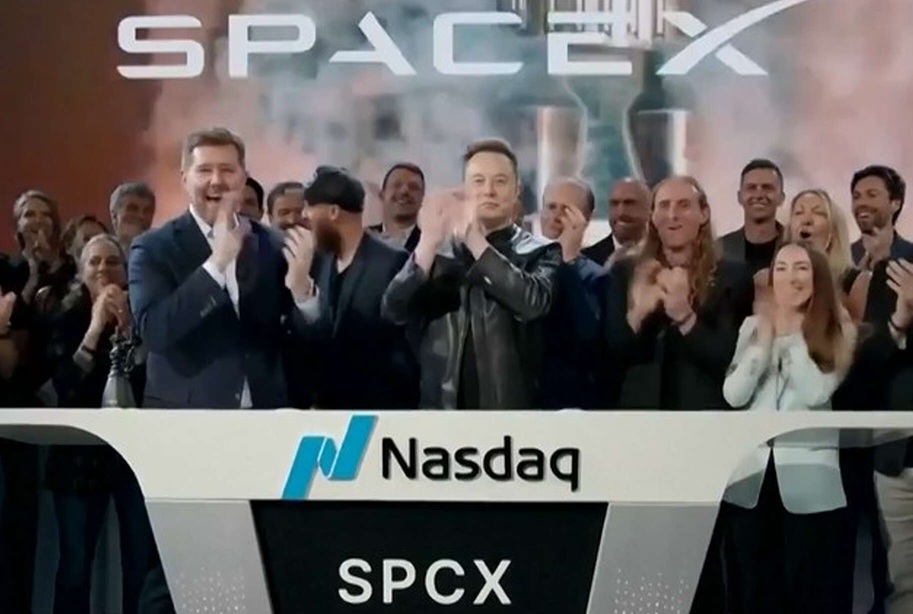
With the launch of SpaceX into the IPO frontier today, the space industry has its newest publicly traded juggernaut. SpaceX's initial pu
With the launch of SpaceX into the IPO frontier today, the space industry has its newest publicly traded juggernaut.
SpaceX’s initial public offering, or IPO, went live for trading on the Nasdaq on June 12, riding on what you could call the “Elon factor”, the high anticipation to grab stock in a company that once aimed for Mars, but now seems to be aiming at everything else, too.
Last May, SpaceX filed with the United States Securities and Exchange Commission key documentation that signaled an initial public offering (IPO) of stock. Talk of SpaceX, which billionaire Elon Musk founded in 2002 to find a way to Mars, going public had been rampant since late 2025, when the first hints arose of its possibility.

And this week, the long-anticipated IPO hit the streets, becoming the largest IPO in history, a $1.77 trillion dollar valuation. SpaceX anticipated a $75 billion initial offering, with shares valued at $135 each, a dollar number that SpaceX can modify on its own.
But today, as the NASDAQ trading began, SpaceX stock began trading at $155 a share, ultimately closing at just above $161 a share. Elon Musk became the world’s first trillionaire in the first 20 minutes of trading, according to the New York Times.
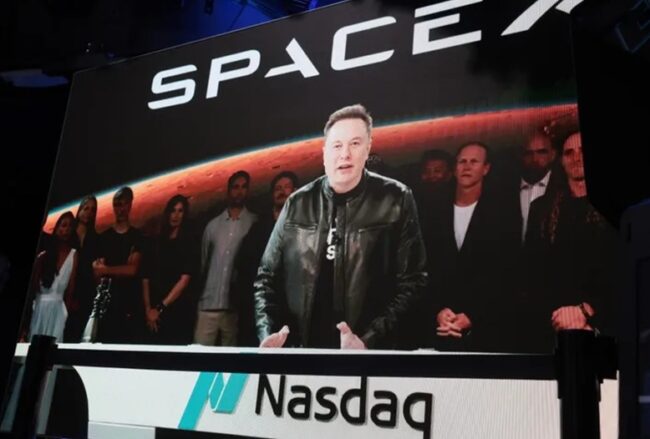
Musk was not in New York City as trading began, choosing to celebrate at the company’s Starbase, Texas facility with around 5,000 supporters.
“It is certainly hard to believe that little company that started in a warehouse in El Segundo is now going public with the largest IPO ever,” Musk said during an opening ceremony broadcast by Nasdaq. “I gave SpaceX less than a 10% chance of succeeding at all, to be clear.”
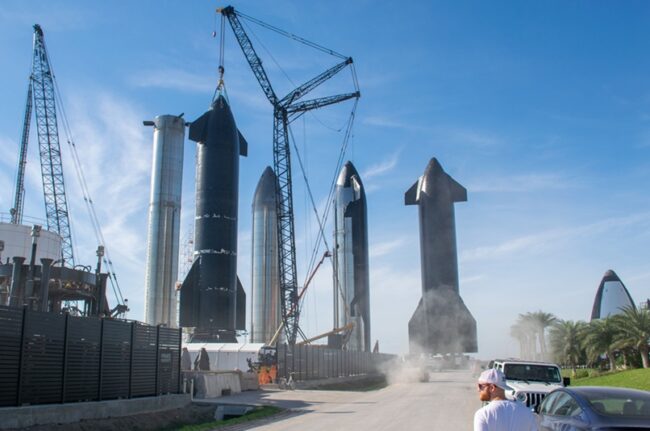
SpaceX transitioning to a publicly traded company is a big deal, not only cash wise but may well power the future and potency of commercial space overall.
Shaun Davies is an associate professor of finance at the Leeds School of Business at the University of Colorado Boulder. He thinks the SpaceX IPO will absolutely provide investors, entrepreneurs, and bankers with valuable information about the market’s appetite for space-related companies.
“That said, I would be careful about viewing SpaceX as a pure test of the space startup sector,” Davies told Space.com.
SpaceX today, Davies said, is much more than a launch company. Investors are evaluating a combination of commercial space operations, Starlink’s global broadband network, and increasingly its artificial intelligence (AI) related ambitions through xAI, founded by Musk in 2023.
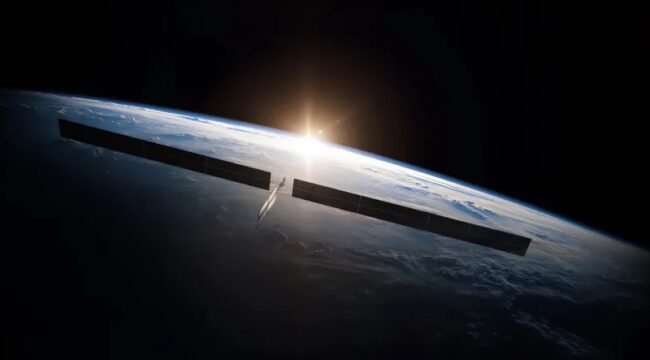
In many ways, SpaceX resembles a diversified technology and infrastructure company as much as a traditional aerospace company, Davies said.
“If the IPO is successful, I do think it could create momentum for other aerospace and advanced transportation companies. Firms pursuing next-generation aviation technologies, including companies such as Boom Supersonic, could benefit from increased investor interest in frontier transportation and aerospace businesses,” he added. “However, many of those companies are still several years away from being public-market ready.”
As for the big picture, if SpaceX raises approximately $75 billion as currently expected, Davies said it would comfortably be the largest IPO in history and would raise more capital than all U.S. IPOs raised during the peak year of the dot-com boom.
“That’s a remarkable milestone in itself,” Davies said, observing that the IPO raise is different from the value of the SpaceX, which is roughly $2 trillion. “What’s perhaps even more interesting is that SpaceX may not hold the record for very long.”
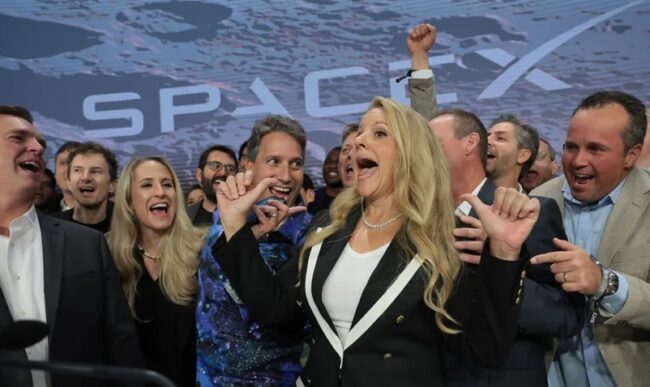
SpaceX President Gwynne Shotwell rang the opening bell in at Nasdaq’s Marketsite in New York surrounded by supporters, friends and family. Confetti rained down as trading began.
“I am so proud of this team,” Shotwell said as she recounted the company’s successes from its first orbital launch to rocket reuse, to launching astronauts for NASA, developing its Starship megarocket and to expanding into artificial intelligence and more.
“Elon founded this company in 2002 initially to build rockets and spaceships that will take humans to Mars, the moon, and even beyond,” Shotwell said. “We’ve not quite gotten to Mars, we’re almost at the moon.”
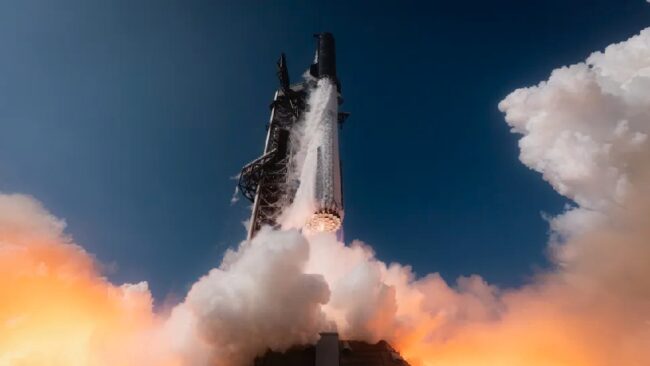
Before trading even began, SpaceX celebrated with a rocket launch, a Falcon 9 mission that sent 29 satellites into orbit. It may have been a risky move for some companies to launch on IPO day, but Falcon 9 launches seem routine now, flying multiple times a week (there was one yesterday, too).
“What company would do such a thing on the day that they open in the public market?” Shotwell asked. “SpaceX, right?”
Watershed moment
“SpaceX’s IPO is a watershed moment for both the industry and the financial markets,” said Jeffrey Manber, special representative to the chairman and CEO of Voyager Technologies, a defense and space technology firm.
“Though the public SpaceX is far more than a rocket company and far more than a space company, it nonetheless is as impactful a moment as what Microsoft was to software and Google to the internet,” Manber said.
Manber seemed struck on how far private space endeavors have come.
Scaling to cosmic heights
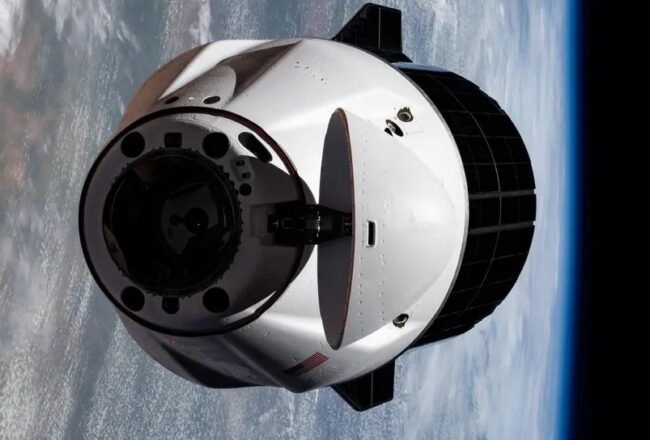
What makes Manber most optimistic is that there is a straight line from the 2008 NASA cargo contract to the International Space Station and the SpaceX Starlink internet satellite constellation.
“But at the time doubters kept saying there is no demand for low Earth orbit transportation and that SpaceX would remain dependent on NASA funding forever.” Manber said. What Elon Musk did, he added, was show that, with the government as a customer, the commercial markets are scalable to incredible heights.
According to Manber, space is now its own asset class.
There are specialized investment vehicles just for commercial space services. Investors can support companies focused on everything from launch services to Earth observation to lunar services, and even to new spaceports, he said.
And the mind-boggling amount of wealth created by the SpaceX IPO, about 4,400 current and former SpaceX employees are expected to become millionaires, according to the New York Times, has led Manber to make a pretty safe prediction.
“One of the unanticipated impacts of the SpaceX IPO will be the literally dozens and dozens of newly minted commercial space entrepreneurs who will self-fund their own companies,” he said. “A true explosion in commercial space services is about to be realized, thanks to the transfer of wealth to hundreds of SpaceX employees.”
All Credit To: Space.com


COMMENTS