
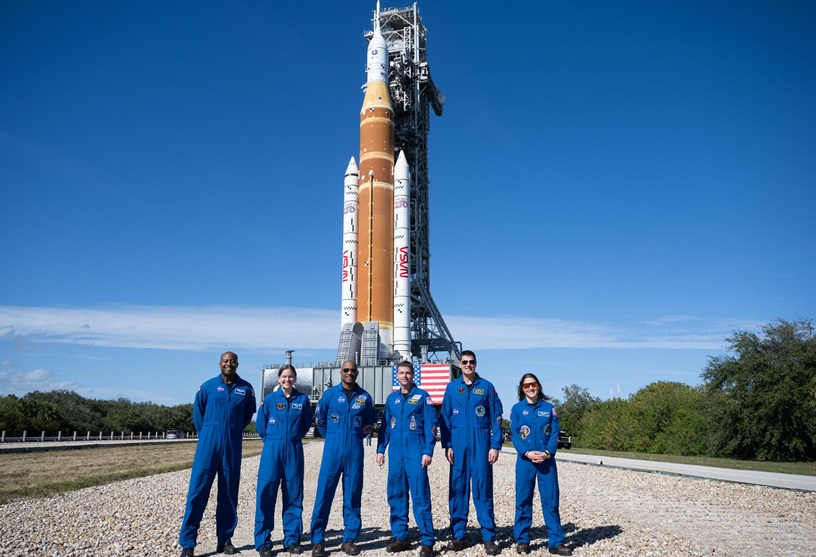
Artemis II is NASA’s first crewed test flight in the Artemis campaign. As early as March, four astronauts will fly aboard NASA’s Orion spacecraft and
Artemis II is NASA’s first crewed test flight in the Artemis campaign. As early as March, four astronauts will fly aboard NASA’s Orion spacecraft and confirm the spacecraft’s systems operate as designed in the deep space environment. In this Golden Age of exploration and innovation, the Artemis missions will allow astronauts to explore the Moon for scientific discovery, economic benefits, and help build momentum for the first crewed missions to Mars, reported NASA.gov.
The Artemis II mission profile follows the uncrewed Artemis I flight test by demonstrating a broad range of SLS (Space Launch System) and Orion capabilities for deep space. This mission will prove Orion’s life support systems are ready to sustain crew on future missions and allow the crew to practice operations essential to the success of Artemis III and beyond.

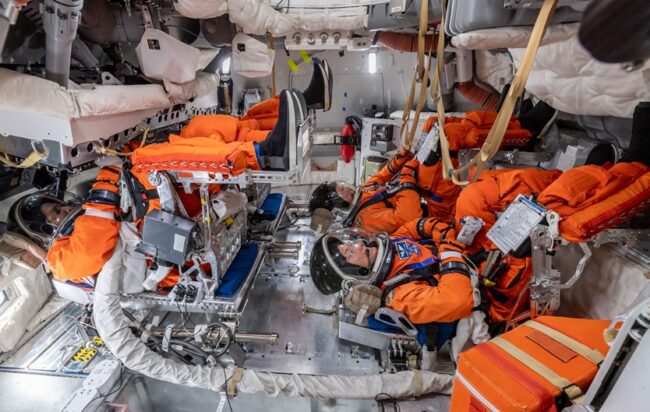
NASA’s Reid Wiseman, Victor Glover, and Christina Koch, and CSA (Canadian Space Agency) astronaut Jeremy Hansen are the Artemis II astronauts, reported NASA.gov.
The initial launch will be similar to Artemis I as SLS lofts Orion into space. With crew aboard this mission, Orion and the upper stage, called the interim cryogenic propulsion stage (ICPS), will then orbit Earth twice to ensure Orion’s systems are working as expected while still close to home.
Orion will start in an elliptical orbit that will be refined to a “safe” high Earth orbit of approximately 44,525 x 115 statute miles. For perspective, the International Space Station flies a nearly circular Earth orbit about 250 miles above our planet, reported NASA.gov.
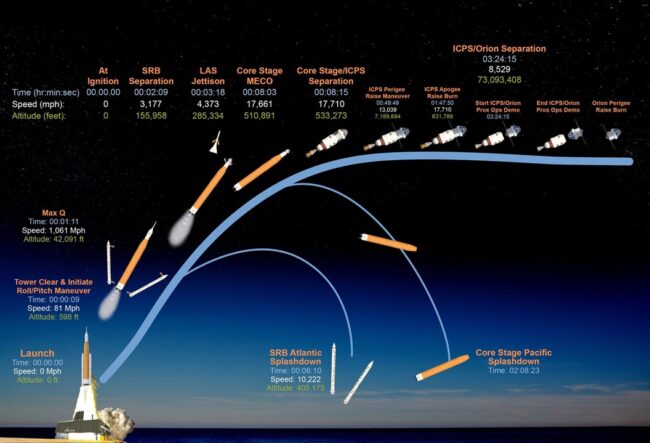
After the burn to enter the high Earth orbit, Orion will separate from the upper stage, which the crew will use as a target for a manual piloting test called the proximity operations demonstration. During the demonstration, mission controllers at NASA’s Johnson Space Center in Houston will monitor Orion as the astronauts transition the spacecraft to manual mode and pilot Orion’s flight path and orientation. This demonstration will provide performance data and operational experience that cannot be readily gained on the ground in preparation for critical rendezvous, proximity operations, and docking, as well as undocking, operations in lunar orbit beginning on Artemis III.
Checking Critical Systems
Following the proximity operations demonstration, the crew will turn control of Orion back to mission controllers at NASA Johnson and spend the remainder of the orbit verifying spacecraft system performance in the space environment.
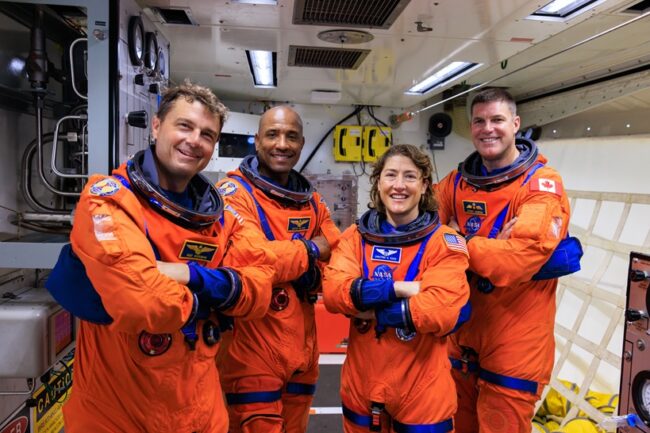
While still close to Earth, the crew will assess the performance of the life support systems necessary to generate breathable air, reported NASA.gov.
Orion also will test the communication and navigation systems to confirm they are ready for the trip. While still in the elliptical orbit around Earth, Orion will briefly fly beyond the range of GPS satellites and the Tracking and Data Relay Satellites of NASA’s Space Network to allow an early checkout of agency’s Deep Space Network communication and navigation capabilities.
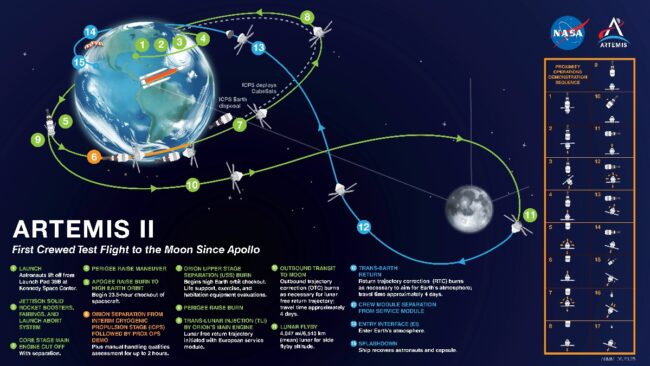
After completing checkout procedures, Orion will perform the next propulsion move, called the translunar injection burn, where Orion’s service module will provide the last push needed to put the spacecraft on an outbound trip of about four days and around the far side of the Moon, tracing a figure eight that will extend more than 230,000 miles from Earth before returning home, reported NASA.gov.
Moonbound, Free Ride Home
On the remainder of the trip, astronauts will continue to evaluate the spacecraft’s systems, including practicing emergency procedures, testing the radiation shelter, taking part in science experiments, and making observations of the Moon from a closer vantage point than human eyes have had in more than 50 years.
The Artemis II crew will travel approximately 4,600 miles beyond the far side of the Moon. They will see the Earth and the Moon from Orion’s windows, with the Moon close in the foreground and the Earth nearly 250,000 miles in the background. From the crew’s location, the Moon will look about the size of a basketball held at arm’s length, reported NASA.gov.
Once Orion and the crew come around the far side of the Moon, they’ll begin the return leg of their journey home. Instead of requiring propulsion on the return, their fuel-efficient trajectory will harness the Earth-Moon gravity field, ensuring Orion will be pulled back naturally by Earth’s gravity for the free-return portion of the mission.
Orion will splashdown in the Pacific Ocean, and the spacecraft and crew will be recovered with the help of the U.S. Navy, offering another opportunity to put new processes to the test for the first time. The lessons learned throughout the mission will pave the way for humans to return to the lunar surface. Through Artemis, NASA will explore more of the Moon than ever before and create an enduring presence in deep space, while simultaneously preparing to land the first astronaut, an American, on Mars, as reported by NASA.gov.
All Credit To: NASA.gov


COMMENTS