
Astronomers have discovered a vast tendril of hot gas linking four galaxy clusters and stretching out for 23 million light-years, 230 times the lengt
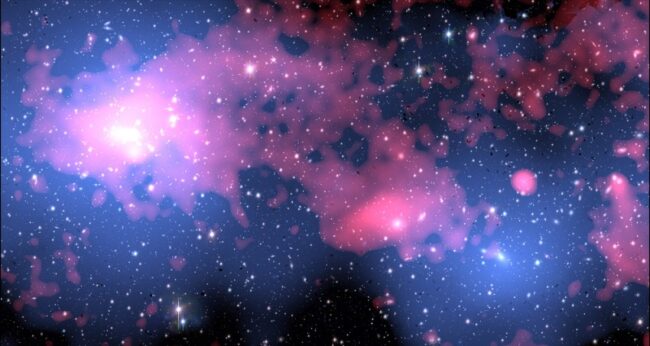
Astronomers have discovered a vast tendril of hot gas linking four galaxy clusters and stretching out for 23 million light-years, 230 times the length of our galaxy. With 10 times the mass of the Milky Way, this filamentary structure accounts for much of the universe’s “missing matter,” the search for which has baffled scientists for decades.
This “missing matter” doesn’t refer to dark matter, the mysterious stuff that remains effectively invisible because it doesn’t interact with light (sadly, that remains an ongoing puzzle). Instead, it is “ordinary matter” made up of atoms, composed of electrons, protons, and neutrons (collectively called baryons) which make up stars, planets, moons, and our bodies, reported Space.com.

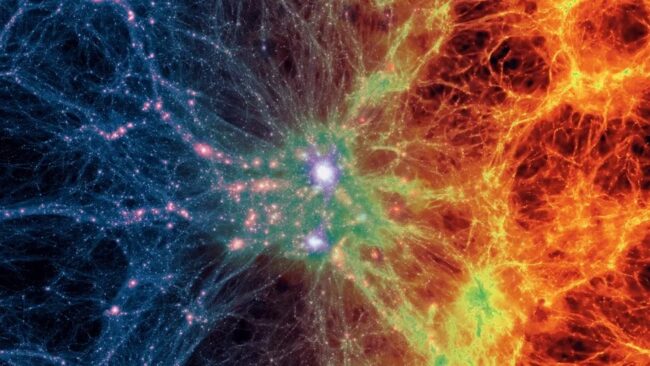
For decades, our best models of the universe have suggested that a third of the baryonic matter that should be out there in the cosmos is missing. This discovery of that missing matter suggests our best models of the universe were right all along. It could also reveal more about the “Cosmic Web,” the vast structure along which entire galaxies grew and gathered during the earlier epochs of our 13.8 billion-year-old universe.
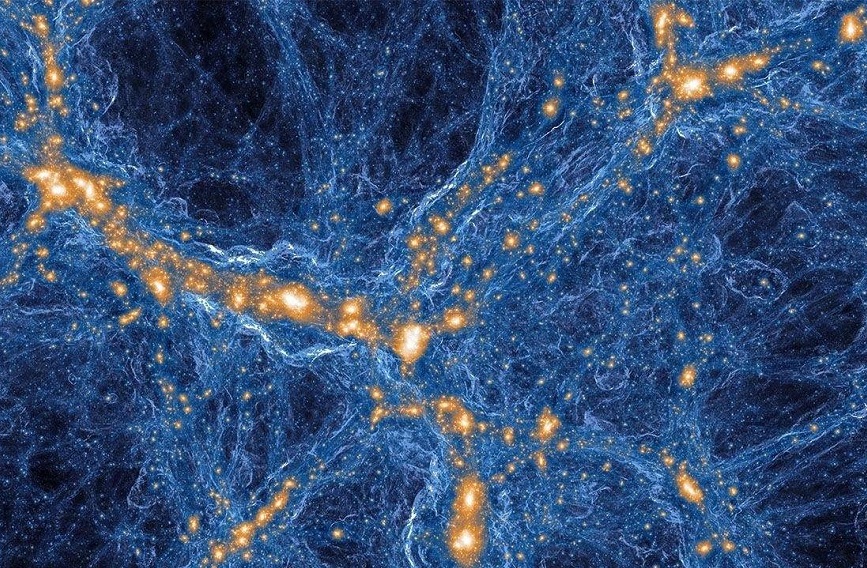
The aforementioned models of the cosmos, including the standard model of cosmology, have long posited the idea that the missing baryonic matter of the universe is locked up in vast filaments of gas stretching between the densest pockets of space, reported Space.com.
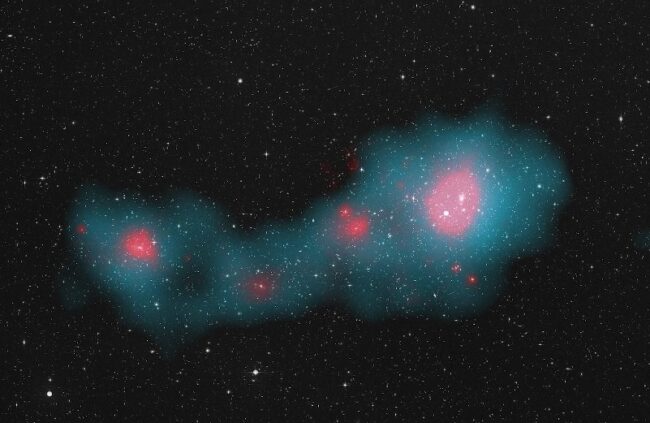
Though astronomers have seen these filaments before, the fact that they are faint has meant that their light has been washed out by other sources like galaxies and supermassive black hole-powered quasars. That means the characteristics of these filaments have remained elusive.
But now, a team of astronomers has for the first time been able to determine the properties of one of these filaments, which links four galactic clusters in the local universe. These four clusters are all part of the Shapley Supercluster, a gathering of over 8,000 galaxies forming one of the most massive structures in the nearby cosmos, reported Space.com.
“For the first time, our results closely match what we see in our leading model of the cosmos – something that’s not happened before,” team leader Konstantinos Migkas of Leiden Observatory in the Netherlands said in a statement. “It seems that the simulations were right all along.”
Missing matter is hot stuff
The newly observed filament isn’t just extraordinary in terms of its mass and size; it also has a temperature of a staggering 18 million degrees Fahrenheit (10 million degrees Celsius). That’s around 1,800 times hotter than the surface of the sun.
The filament stretches diagonally through the Shapely Supercluster, reported Space.com.
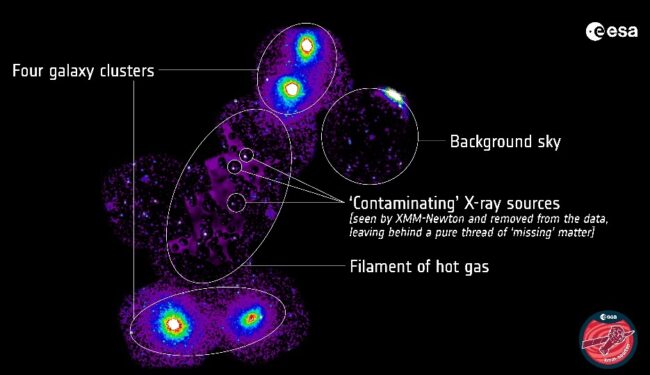
Vital to the characterization of this filament was X-ray data from XMM-Newton and Suzaku, which made a great tag-team of telescopes. While Suzaku, a Japan Aerospace Exploration Agency (JAXA) satellite, mapped X-ray light over a vast region of space, the European Space Agency (ESA) operated XMM-Newton zoomed in of X-ray points from supermassive black holes studded within the filament, “contaminating” it.
“Thanks to XMM-Newton, we could identify and remove these cosmic contaminants, so we knew we were looking at the gas in the filament and nothing else,” team member and University of Bonn researcher Florian Pacaud said. “Our approach was really successful, and reveals that the filament is exactly as we’d expect from our best large-scale simulations of the universe,” reported Space.com.
The team then combined these X-ray observations with optical data from a plethora of other telescopes.
Revealing this hitherto undiscovered tendril of hot matter connecting galaxy clusters has the potential to aid scientists’ understanding of these extreme structures and how they are connected across vast cosmic distances, reported Space.com.
This could, in turn, aid our understanding of the Cosmic Web, filaments of matter that acted as a cosmic scaffold helping the universe to assemble in its current form.
“This research is a great example of collaboration between telescopes, and creates a new benchmark for how to spot the light coming from the faint filaments of the cosmic web,” XMM-Newton Project Scientist Norbert Schartel explained. “More fundamentally, it reinforces our standard model of the cosmos and validates decades of simulations: it seems that the ‘missing’ matter may truly be lurking in hard-to-see threads woven across the universe,” as reported by Space.com.
All Credit To: Space.com


COMMENTS