
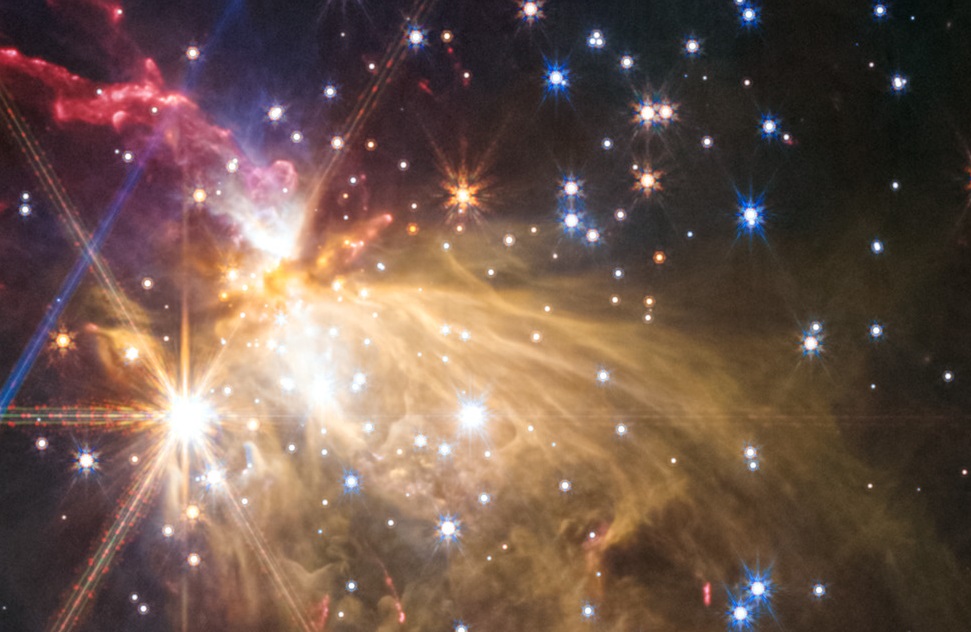
A blowtorch of seething gasses erupting from a volcanically growing monster star has been captured by NASA’s James Webb Space Telescope, reported NAS
A blowtorch of seething gasses erupting from a volcanically growing monster star has been captured by NASA’s James Webb Space Telescope, reported NASA.gov.
Stretching across 8 light-years, the length of the stellar eruption is approximately twice the distance between our Sun and the next nearest stars, the Alpha Centauri system. The size and strength of this particular stellar jet, located in a nebula known as Sharpless 2-284 (Sh2-284 for short), qualifies it as rare, say researchers.

Streaking across space at hundreds of thousands of miles per hour, the outflow resembles a double-bladed dueling lightsaber from the Star Wars films. The central protostar, weighing as much as ten of our Suns, is located 15,000 light-years away in the outer reaches of our galaxy, reported NASA.gov.
The Webb discovery was serendipitous. “We didn’t really know there was a massive star with this kind of super-jet out there before the observation. Such a spectacular outflow of molecular hydrogen from a massive star is rare in other regions of our galaxy,” said lead author Yu Cheng of the National Astronomical Observatory of Japan.
This unique class of stellar fireworks are highly collimated jets of plasma shooting out from newly forming stars. Such jetted outflows are a star’s spectacular “birth announcement” to the universe. Some of the infalling gas building up around the central star is blasted along the star’s spin axis, likely under the influence of magnetic fields, reported NASA.gov.
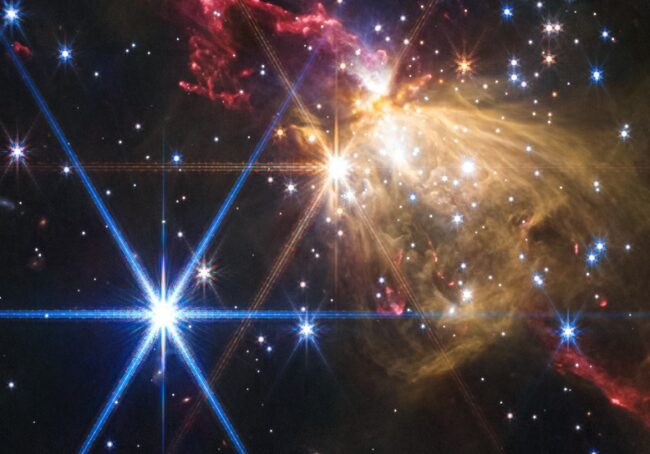
“I was really surprised at the order, symmetry, and size of the jet when we first looked at it,” said co-author Jonathan Tan of the University of Virginia in Charlottesville and Chalmers University of Technology in Gothenburg, Sweden.
Its detection offers evidence that protostellar jets must scale up with the mass of the star powering them. The more massive the stellar engine propelling the plasma, the larger the gusher’s size, reported NASA.gov.
The jet’s detailed filamentary structure, captured by Webb’s crisp resolution in infrared light, is evidence the jet is plowing into interstellar dust and gas. This creates separate knots, bow shocks, and linear chains.
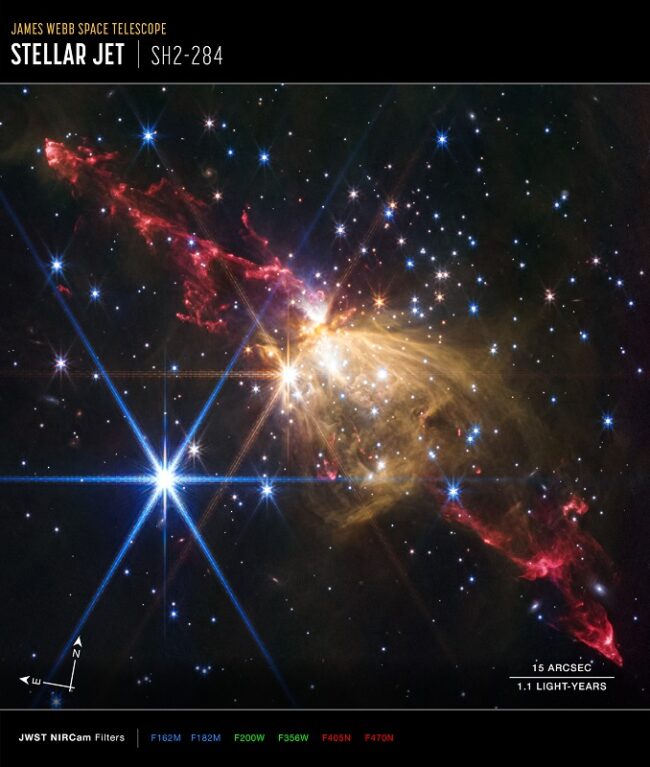
The tips of the jet, lying in opposite directions, encapsulate the history of the star’s formation. “Originally the material was close into the star, but over 100,000 years the tips were propagating out, and then the stuff behind is a younger outflow,” said Tan, reported NASA.gov.
At nearly twice the distance from the galactic center as our Sun, the host proto-cluster that’s home to the voracious jet is on the periphery of our Milky Way galaxy.
Stellar jets, which are powered by the gravitational energy released as a star grows in mass, encode the formation history of the protostar, reported NASA.gov.
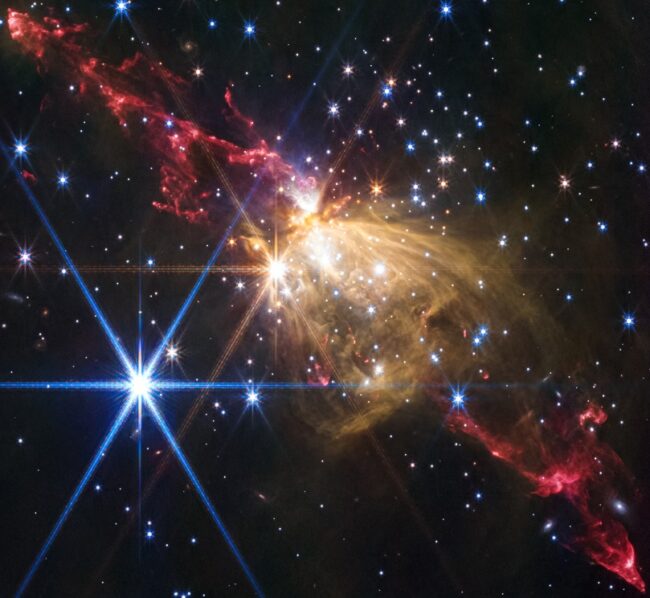
“Webb’s new images are telling us that the formation of massive stars in such environments could proceed via a relatively stable disk around the star that is expected in theoretical models of star formation known as core accretion,” said Tan. “Once we found a massive star launching these jets, we realized we could use the Webb observations to test theories of massive star formation. We developed new theoretical core accretion models that were fit to the data, to basically tell us what kind of star is in the center. These models imply that the star is about 10 times the mass of the Sun and is still growing and has been powering this outflow.”
Where there’s one massive star, there could be others in this outer frontier of the Milky Way. Other massive stars may not yet have reached the point of firing off Roman-candle-style outflows. Data from the Atacama Large Millimeter Array in Chile, also presented in this study, has found another dense stellar core that could be in an earlier stage of construction, as reported by NASA.gov.
All Credit To: NASA.gov


COMMENTS